
Rigidity, Geometry, Dynamics
The inaugural Sydney Mathematical Research Institute (SMRI) Summer School will run from 18 – 29 January 2027 at the University of Sydney. Benson Farb, Alan Reid and Amie Wilkinson will deliver courses inspired by dynamics and low-dimensional geometry and topology. Participants are recommended to choose one course to focus on intensely throughout the period, with the option to follow a second course. Please register your interest in attendance here.
Important dates
Funding applications due:
20 September 2026
Notification for successful financial support applications are expected to be made by 31 October 2026
SMRI Summer School 18 – 29 January 2027
SMRI Summer School 2027
Download the poster for your institution
Profinite rigidity and Grothendieck Pairs
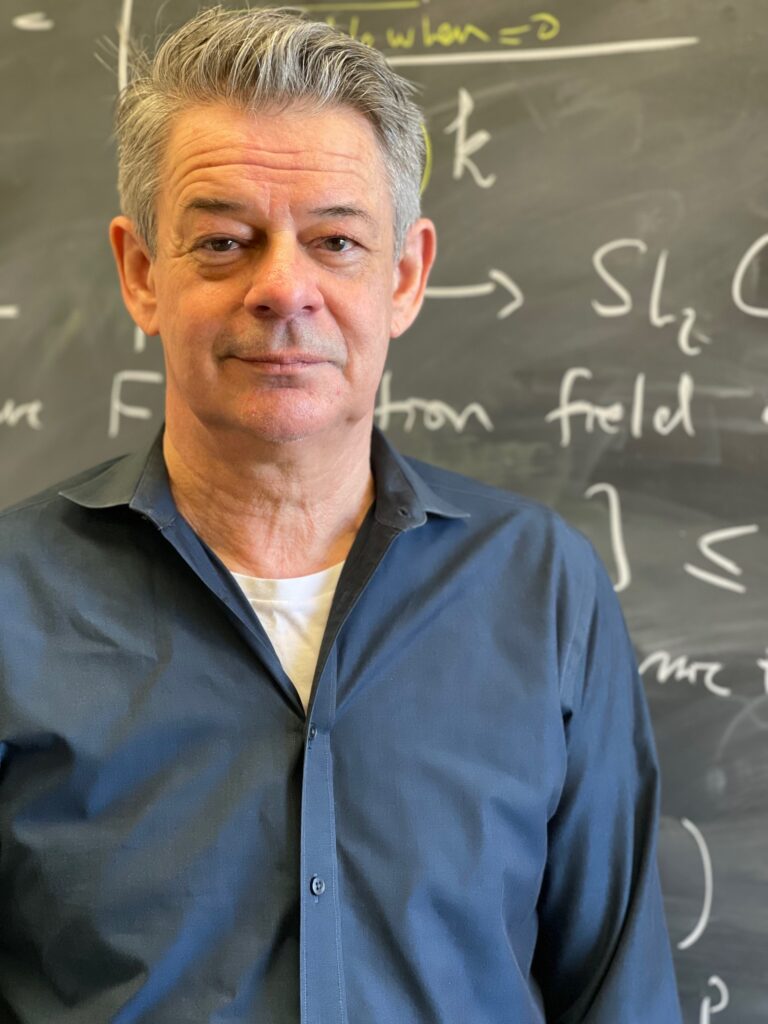
Alan Reid, Rice University
Teaching assistant: Xiaoyu Xu, Peking University
A finitely generated residually finite group G is called profinitely rigid, if for any other finitely generated residually finite group H, whenever the profinite completions of H and G are isomorphic, then H is isomorphic to G.
In this lecture series, we will:
(1) Review what is known (and conjectural) about profinite rigidity in the context of groups arising in low-dimensional geometry and topology.
(2) Discuss constructions to demonstrate when profinite rigidity fails, and in particular the setting of Grothendieck Pairs.
(3) Discuss properties which are profinite invariants and those that are not.
Many open problems will be sprinkled through the lectures.
Alan Reid is the Edgar Odell Lovett Chair of Mathematics at Rice University. He is a Fellow of the American Mathematical Society (AMS) and a Corresponding Fellow of the Royal Society of Edinburgh. His research focuses on geometric group theory, hyperbolic geometry and the topology of 3-manifolds. Reid was awarded a 2026 Frontiers of Science Award from the International Congress of Basic Science (ICBS) for outstanding contributions in the area of this course .
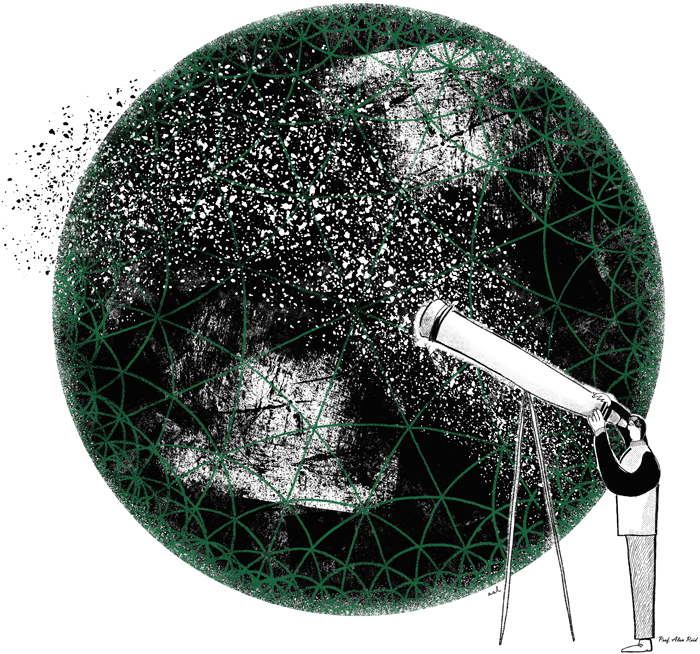
Algebraic geometry from a topological viewpoint
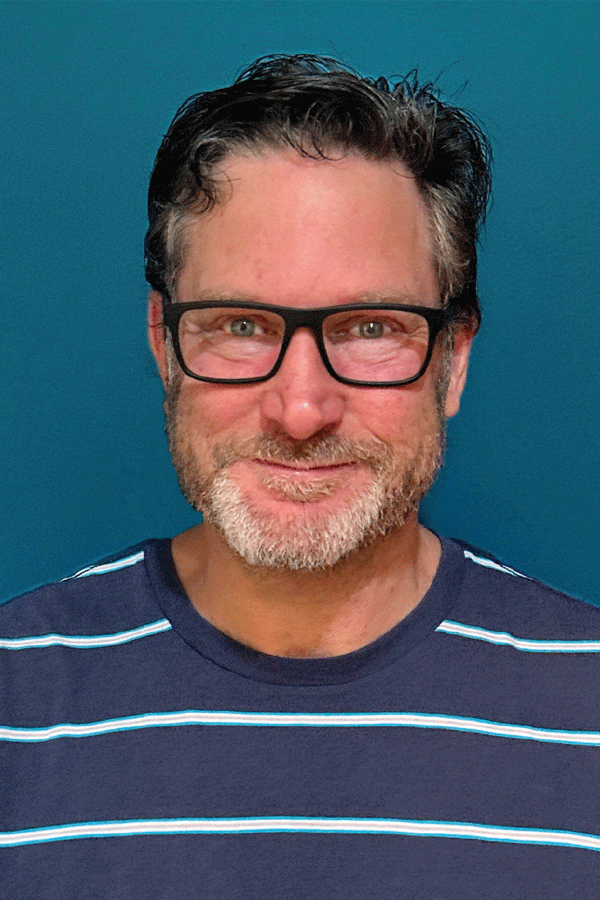
Benson Farb, University of Chicago
Teaching assistant: TBA
This will be a crash course on algebraic geometry for people who know only first-year graduate algebraic and differential topology. We will focus on proving deep, beautiful theorems using just this background. Along the way we will explore what Hodge theory is and why it is so useful. We will then connect this material to modern research topics, possibly including the study of moduli spaces, monodromy, 4-manifold theory (through algebraic surfaces) and (if there is interest) arithmetic geometry.
Benson Farb is the Ann Gillian Sheldon Professor of Mathematics at the University of Chicago. Farb obtained a PhD at Princeton University in 1994 under the direction of William Thurston. He then went for a postdoc at the University of Chicago and never left. Farb is currently interested in interactions between topology and algebraic geometry, but he has written papers in geometric group theory, low-dimensional topology, dynamical systems, differential geometry, Lie theory, Teichmüller theory, cohomology of arithmetic groups, homological stability, algebraic geometry and connections among these topics. Farb was an invited speaker at the 2014 ICM (Topology section), was elected to the American Academy of Arts and Sciences in 2021, and won the AMS Steele Prize (with his former student Dan Margalit) in 2024. He has supervised 58 PhD students and has been senior scientist for 17 NSF postdocs.
Symmetry in dynamics
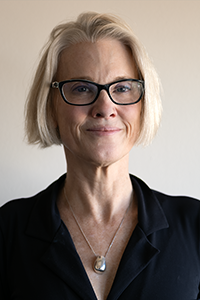
Amie Wilkinson, University of Chicago
Teaching assistant: Sven Sandfeldt, University of Chicago
Symmetry groups of dynamical systems often reflect hidden structure. In this minicourse we will study centralizers and related symmetry groups of smooth dynamical systems, beginning with familiar examples on the circle and torus and moving toward hyperbolic and partially hyperbolic systems. A guiding theme is that complicated dynamics tends to destroy symmetry, while the presence of large symmetry often forces a rigid, often algebraic, model. Along the way we will see how periodic orbit data, invariant foliations, entropy, and smooth structure constrain one another. The emphasis will be on examples, exercises, and concrete mechanisms rather than technical generality.
Amie Wilkinson is a Professor of Mathematics at the University of Chicago studying dynamical systems and ergodic theory. She received the 2011 Satter Prize in Mathematics, was elected a fellow of the AMS in 2014, Academia Europaea in 2019 and the American Academy of Arts and Sciences in 2021.
Tentative Schedule
Week 1 (Monday 18 January – Friday 22 January 2027)
| Monday 18 January | Tuesday 19 January | Wednesday 20 January | Thursday 21 January | Friday 22 January | |
|---|---|---|---|---|---|
| 9:30 am – 10:45 am | Farb lecture | Wilkinson lecture | Reid lecture | Farb lecture | Wilkinson lecture |
| 10:45 am – 11:15 am | Morning tea | Morning tea | Morning tea | Morning tea | Morning tea |
| 11:15 am – 12:30 pm | Reid lecture | Farb lecture | Wilkinson lecture | Reid lecture | Farb lecture |
| 12:30 pm – 3:00 pm | Lunch break | Lunch break | Lunch break | Lunch break | Lunch break |
| 3:00 pm – 3:45 pm | Farb problem session | Wilkinson problem session | Reid problem session | Farb problem session | Wilkinson problem session |
| 3:45 pm – 4:15 pm | Afternoon tea | Afternoon tea | Afternoon tea | Afternoon tea | Afternoon tea |
| 4:15 pm – 5:00 pm | Reid problem session | Farb problem session | Wilkinson problem session | Reid problem session | Farb problem session |
Week 2 (Monday 25 January – Friday 29 January 2027)
| Monday 25 January | Tuesday 26 January (Public holiday) | Wednesday 27 January | Thursday 28 January | Friday 29 January | |
|---|---|---|---|---|---|
| 9:30 am – 10:45 am | Reid lecture | ECR lightning talks | Farb lecture | Wilkinson lecture | Reid lecture |
| 10:45 am – 11:15 am | Morning tea | Morning tea | Morning tea | Morning tea | Morning tea |
| 11:15 am – 12:30 pm | Wilkinson lecture | ECR lightning talks | Reid lecture | Farb lecture | Wilkinson lecture |
| 12:30 pm – 3:00 pm | Lunch break | Lunch break | Lunch break | Lunch break | Lunch break |
| 3:00 pm – 3:45 pm | Reid problem session | ECR lightning talks | Farb problem session | Wilkinson problem session | Reid problem session |
| 3:45 pm – 4:15 pm | Afternoon tea | – | Afternoon tea | Afternoon tea | Afternoon tea |
| 4:15 pm – 5:00 pm | Wilkinson problem session | – | Reid problem session | Farb problem session | Wilkinson problem session |
Financial support
Accommodation
We have a limited number of fully-funded places at Sancta Sophia College, The University of Sydney. This includes accommodation, breakfast and dinner with arrival on Sunday 17 January and departure on Saturday 30 January. Please indicate in the application form whether you would like to be considered for a spot at Sancta Sophia.
Partial travel support
We have a limited number of spots for partial support towards travel costs. Please indicate in the application form whether you would like to be considered for travel support. Funding is limited to a maximum of AUD 2000 for Europe, AUD 1000 for Asia, AUD 2000 for Americas, AUD 200 for domestic travel.
Local information
More information about travelling to the University of Sydney and Australia in general, including information about visas can be found on our Local information for visiting researchers page.