
Take a look at modern mathematics, and a sprawling landscape emerges. How do we navigate and orient ourselves in an environment that we can’t see, dealing with objects so intricate and complex that their structure and use is uncertain? The tools needed for the job are not always clear and yet, some of these objects reveal themselves to be quiet unifiers with the potential to link distant fields and encode deep structure. One of these creations is the Kazhdan–Lusztig polynomials.
In 1979, David Kahzdan and George Lusztig unearthed these polynomials in their studies of the representation theory of Lie algebras, reducing symmetries to their algebraic forms. Since their discovery, these structures have appeared across other mathematical domains including geometry and combinatorics. They have also been found to encode information about singularities of Schubert varieties, a type of geometric space, as well as Lie and Hecke algebras, constructions in this area of pure mathematics.
Despite their algebraic origin, Kazhdan-Lusztig polynomials have deep ties to combinatorics, a branch of mathematics concerned with counting and discrete structure. Kazhdan-Lusztig polynomials are defined by elements in a Coxeter group, a kind of ubiquitous algebraic object which models reflections, or symmetries, in space. For mathematician Christian Gaetz and others studying these polynomials, these structures are defined by a complicated reccurrence, although how exactly their interesting properties arise from this definition has remained obscure.
One example of the difficulty of extracting these properties is Ben Elias and Geordie Williamson’s establishment of the Kazhdan–Lusztig positivity conjecture in 2014, which followed many years after the conjecture was originally proposed in 1979. In 2026, Christian Gaetz and his collaborators Grant Barkley and Thomas Lam developed their proof that a specific part of Kazhdan-Lusztig polynomials depend on simple combinatorial data, outlined in their preprint, Combinatorial Invariance for the Coefficient of \({q}\) in Kazhdan-Lusztig Polynomials.
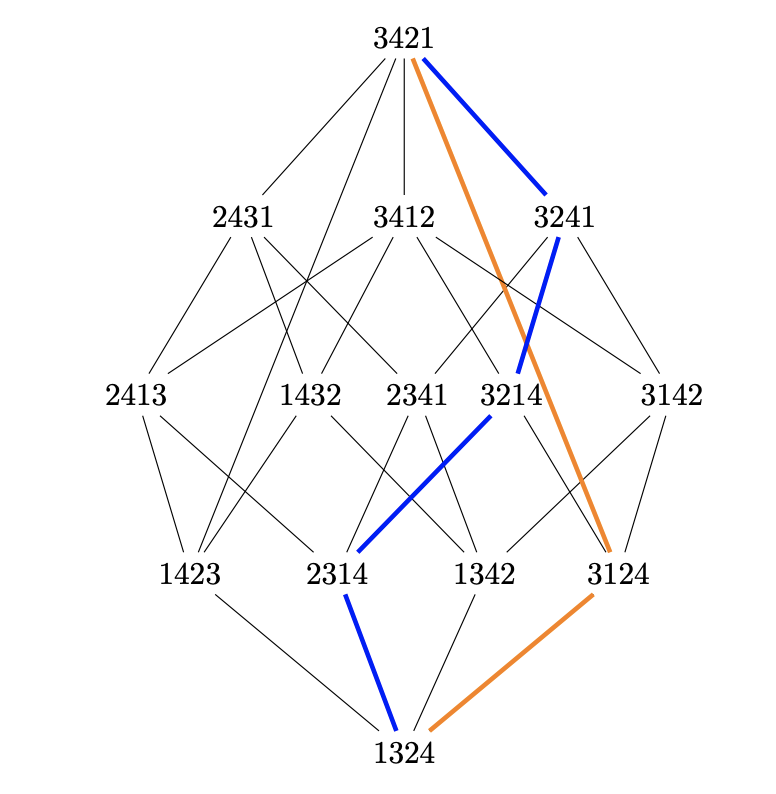
The Combinatorial Invariance Conjecture proposes that a Kazhdan–Lusztig polynomial is dependant on a partially ordered set: an interval in a Bruhat order – another definition which determines when one Coxeter group element is “bigger” than another. Christian described that, “…this is really intriguing to me because it is so surprising; it is really unclear how such rich geometric and representation theoretic information could be determined completely combinatorially”. To prove these conjectures and crack the understanding of this new landscape, mathematicians need to develop new methodologies and understandings of Kazhdan–Lusztig polynomials.
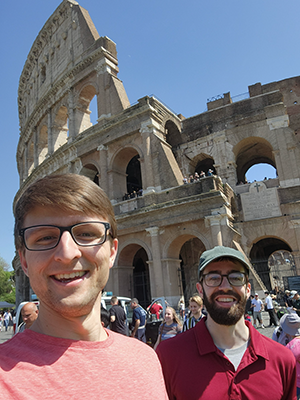
Christian Gaetz is an assistant professor at the University of California, Berkeley, working in algebraic combinatorics. He uses combinatorial objects like graphs and partially ordered sets to crack problems in representation theory and geometry, and vice-versa to solve combinatorial problems. His graduate studies were at MIT, which solidified his interest in combinatorics, being a major centre for the field.
Christian has worked on the Combinatorial Invariance Conjecture with his collaborator Grant Barkley since 2022 when they were both based at Harvard. Both interested in Coxeter groups and the Bruhat order, the new conjectural approach to the Combinatorial Invariance Conjecture pioneered by Geordie and his collaborators at DeepMind generated a lot of excitement for the possibilities of a combinatorial approach to existing problems in Kazhdan–Lusztig theory.
In 2025, the special semester, Modern perspectives in representation theory, ran at the Sydney Mathematical Research Institute, offering a unique opportunity for Christian and Grant to visit SMRI and collaborate with Thomas Lam and Geordie, co-organisers of the special semester. Although they had corresponded previously, Christian explained that he jumped at the chance to visit SMRI to collaborate with the organisers and other visitors. “It was really stimulating to have so many experts under one roof, who knew about Kazhdan–Lusztig polynomials and the Bruhat order from different perspectives.” The accelerant for mathematical progress was the physical presence of so many mathematicians interested in these concepts in one place, as well as plenty of the essentials: chalk and coffee. A rotating group of visitors also helped keep new ideas flowing, Christian reflected.
At SMRI, discussions on recent progress on cluster structures for Richardson varieties (pieces of Schubert varieties) paved the way to explore and extend the ideas of Matthew Dyer and Leonardo Patimo to prove the Combinatorial Invariance Conjecture for the linear coefficient of Kazhdan–Lusztig polynomials. However, for Christian and his collaborators, they could still not see how to make the new approach work.
It took several more months for progress: in late 2025, Grant started a postdoc at the University of Michigan, and was able to revive discussions with Thomas Lam. When Grant visited Christian at Berkeley again later in the year, they finally realized how to make the proof work.
At its heart, the Combinatorial Invariance Conjecture suggests that Kazhdan–Lusztig polynomials are determined by the combinatorial structure of intervals in the Bruhat order, a kind of shape connecting two elements. From their algebraic origins, this would indicate that Kazhdan–Lusztig polynomials have a combinatorial basis, with simple patterns underlying these extraordinary structures. These structures present an irresistible problem to mathematicians as a tool to probe connections between different areas of mathematics and uncover surprising connections.