
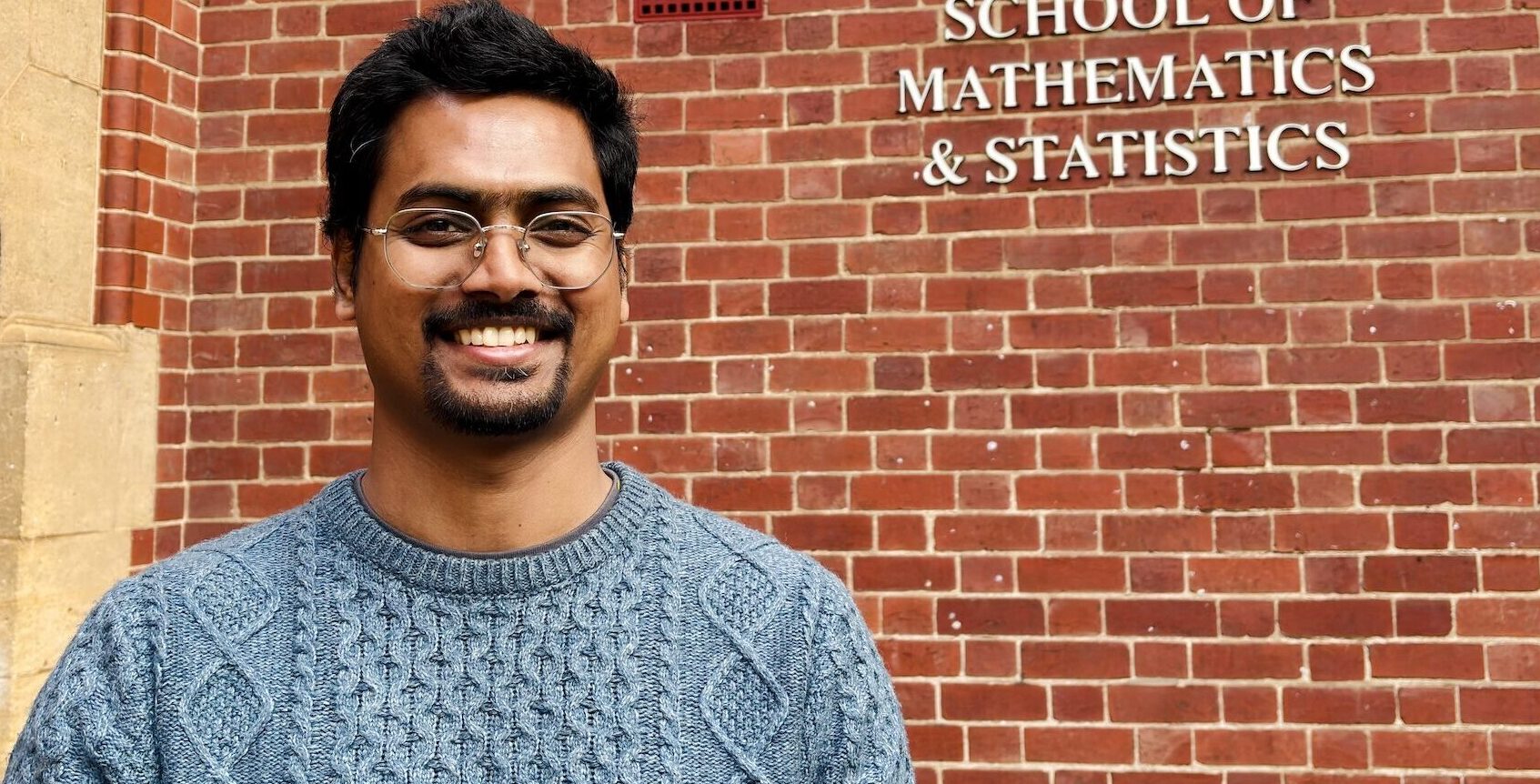
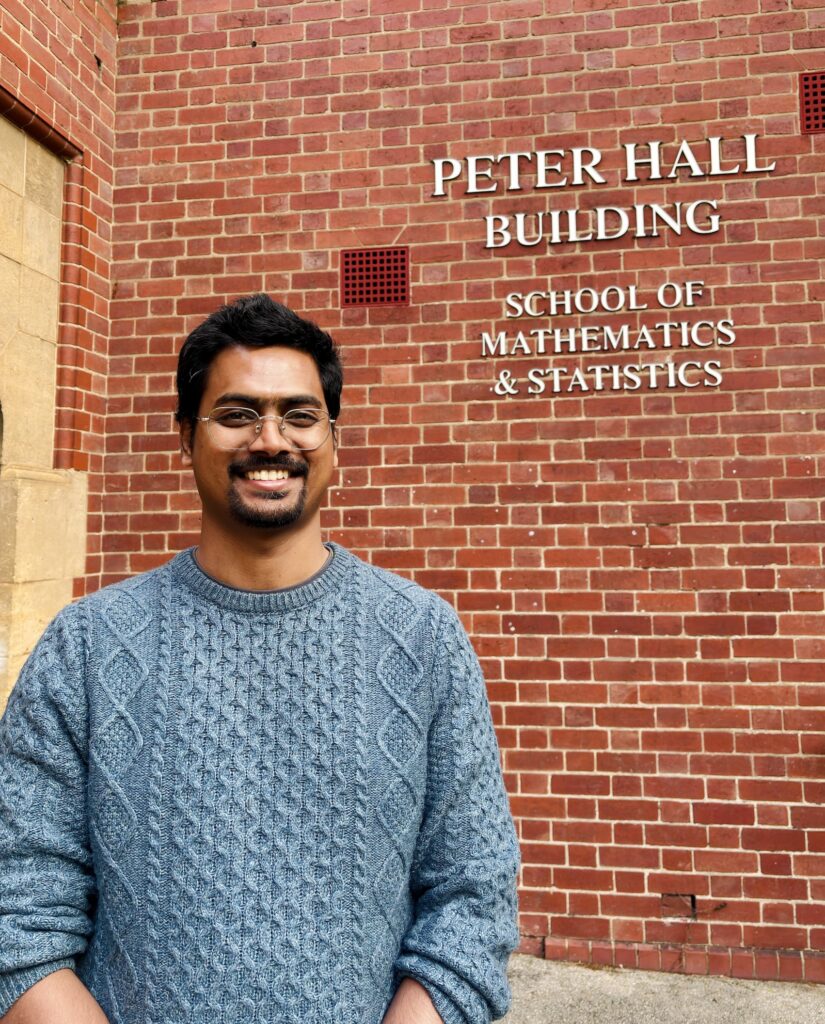
Chandan Singh visited SMRI as a Lift-Off Fellow – a fellowship introduced by The Australian Mathematical Society to support young mathematicians as they transition from their PhD and their first postdoctoral position. The Lift-off Fellowships are awarded on the basis of academic merit, and the field of applicants for these fellowships is very strong.
We spoke to Chandan about his research, his time at SMRI, and the impact the fellowship has had on his career.
Tell us about the research you were working on during your time as a Lift-Off Fellow at SMRI
“I worked on problems at the intersection of Grothendieck–Teichmüller (GT) theory and Kashiwara- Vergne (KV) problem.”
“My research explores how geometric structures can help us understand complex algebraic symmetries. In particular, I study the operadic and cyclic-operadic structures arising from braid groups and how they can be used to characterise the Grothendieck–Teichmüller group. My broader aim is to understand abstract algebraic symmetries through their underlying geometric and topological structures.”
“One question that particularly interests me is whether important symmetry groups can be characterised intrinsically by the structures they preserve. This grew out of my PhD at the University of Melbourne and have led to further questions about associators and the Kashiwara–Vergne problem.”
Who did you collaborate with at SMRI?
“I worked closely with Associate Professor Zsuzsanna Dancso, with whom I have an ongoing collaboration, and with her PhD student, Joel Richardson.”
“My discussions with Zsuzsanna and Joel were particularly valuable for deepen my understanding and developing ideas about Goldman-Turaev formality from Kontsevitch integral, its connections with associators and the Kashiwara–Vergne problem. These discussions helped me to broaden my perspective on how questions from Grothendieck–Teichmüller theory connects with quantum topology and Lie theory.”
You came to SMRI as a Lift-Off Fellow. What impact has the fellowship had on your career?
“One of its most valuable aspects was having protected time to focus on research and to think more broadly about the directions I wanted to pursue. For an early-career researcher, having time, intellectual space, and access to a broader mathematical community are extremely valuable.”
“It also helped me to see more clearly how different parts of my work—on operadic and homotopical methods in Grothendieck–Teichmüller theory and the Kashiwara–Vergne problem—fit together as part of a larger research program.”
What was your experience of working at SMRI like?
“Extremely positive. I had dedicated time and space to concentrate on research, and I was surrounded by mathematicians working in other areas.”
“Research mathematics involves a lot of focused individual work, but talking with other researchers matters just as much, and SMRI provided a very good balance between the two. Informal conversations, seminars and research discussions put me in front of ideas outside my own area and made me look at my own work from a broader perspective.”
What have you been working on since?
“I have kept developing several closely related research directions. SMRI supported me to visit Dionne Ibarra at Monash University to explore temporary Lie bialgebra connection from my work.”
“One strand of my work concerns cyclic structures associated with ribbon-braid groups and their relationship with Grothendieck–Teichmüller theory. I am interested in understanding how additional symmetries of knotted objects can lead to new ways of understanding Grothendieck–Teichmüller-type groups and Kashiwara-Vergne type groups in Lie algebras.”
“Another direction concerns the Kashiwara–Vergne problem and its connections with different braid groups and Drinfeld associators. Together with collaborators, I have been studying how solutions of the Kashiwara–Vergne type problems can arise naturally from topological constructions.”
“More recently, I have also been exploring extensions of these ideas to settings involving punctures and mixed braids. The broader aim is to understand whether the same structural principles—operadic composition, braid symmetries and associators—continue to organise these more general situations.”
“As we speak today, I am happy to report that I finished an article on establishing connections between operadic and nould theoretic characterisation of the graded Grothendieck-Teichmüller group. Much of the initial brainstorming and development of the ideas behind this paper took place during my time at SMRI.”
Is there anything else you would like to share about your time at SMRI?
“My time at SMRI helped me strengthen my research program and my existing collaborations. It also helped me pin down the questions I want to keep pursuing.”
“I’m very grateful to SMRI for hosting me as a Lift-Off Fellow. Programs like this matter most at the point where you’re moving from a PhD to the next stage of an academic career.”