
SMRI is pleased to announce the appointment of two new Deputy Directors. Milena Radnović, Deputy Director (Engagement), and Tiangang “TC” Cui, Deputy Director (Research) will commence their appointments in April 2026 and work alongside current Director Geordie Williamson and Executive Director Stephan Tillmann. This Q&A will introduce Milena and TC and outline their vision for SMRI.
Could you tell us about your research interests?
Milena: My research interests lie in geometry, dynamics, and integrable systems. I draw much of my inspiration from the elegance of classical geometry, and one of my favourite mathematical results is Poncelet’s porism, discovered more than two centuries ago. This beautiful theorem states that if a polygon can be drawn so that it is inscribed in one conic and circumscribed about another, then infinitely many such polygons exist, and they all have the same number of sides, as shown in the image below (Poncelet porism applied to elliptic billiard).
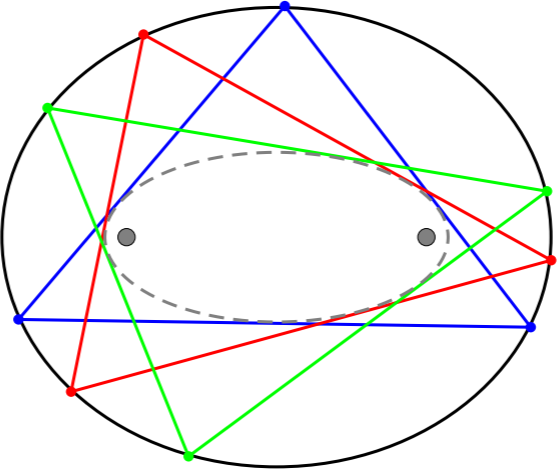
I enjoy working with mathematical billiards—idealised models of motion that reveal surprising complexity beneath simple rules. More broadly, I am fascinated by how very different systems arising in mathematics and physics often share common principles, pointing to deep and universal structures arising from geometry and algebra. Such phenomena are characteristic of integrable systems, which form a central focus of my research.
TC: My current research interests are in inverse problems, data assimilation, and uncertainty quantification. Broadly speaking, they sit at the intersection of computational mathematics, statistical modelling, and applied probability, in what people now often call scientific machine learning. These interests grew out of my early research on computational modelling for subsurface energy applications, especially geothermal systems. In that work, some fundamental mathematical challenges came up very naturally: how to accelerate large-scale solvers that can take hours or even days to run; how to scale algorithms to high-dimensional problems; and more broadly, how to combine mathematical models with data in a principled way to make better predictions and support decision-making under uncertainty. I found myself increasingly drawn to these deeper questions, and that gradually led me from more applied research towards different problems in mathematics.
What are you most excited about in your new role at SMRI?
Milena: I am excited about joining a team that shares my passion for mathematics and is deeply committed to presenting it as both profoundly useful and magnificently beautiful to a broad audience, while fostering an environment in which mathematical talent can thrive. I look forward with great enthusiasm to contributing to this meaningful pursuit.
TC: What excites me most about this role is really the chance to help shape SMRI as a place that is both intellectually ambitious and genuinely welcoming. I would love to contribute to seminars, research events, and visiting programs, and also to help build longer focused research periods or special semesters, similar to programs at the Newton Institute, the Institute for Pure & Applied Mathematics and the Institute for Mathematical and Statistical Innovation.
I also think some of the most valuable parts of a research institute come from the less formal side of things. For example, discussion groups, informal conversations, and opportunities for visitors, early-career researchers, and colleagues in the School provide opportunities to interact more naturally and spark new collaborations. I also like the idea of helping SMRI think ahead about where mathematics is going, including how the field is changing in the AI era.
How do you see SMRI’s role in the landscape of the mathematical sciences, both here in Australia and globally?
Milena: It has been a genuine privilege to witness SMRI’s growth from its very beginnings to its current role as a centre of mathematical vitality in Australia. Over this time, SMRI has come to share both the mission and standing of world‑leading research institutes that place focus to nurturing strong visitor programs and foster broad engagement.
TC: I see SMRI as a national hub that can bring together researchers from different institutions and career stages, and help build the critical mass needed to develop focused areas of mathematical research. Internationally, I think SMRI has the opportunity to be a highly visible, welcoming, and intellectually vibrant institute that attracts leading visitors, fosters long-term collaborations between the Australian and international mathematical communities, and runs timely research programs around emerging topics.
In that sense, SMRI is not just a venue for excellent research, but also a place that connects people, sparks new ideas, and helps shape new directions. More broadly, I would hope to see SMRI continue to grow as a place where fundamental mathematics engages in a meaningful way with major scientific and societal challenges.